
How to use Elbow Crutches safely
How to use elbow crutches
Crutches are commonly used after an operation or injury to help you walk safely while reducing the amount of weight placed through one leg. Using the correct crutch walking technique can help improve confidence, reduce the risk of falls and allow you to gradually return to normal walking.
The technique you have been advised to use will depend on your operation or injury, your balance and how much weight you are allowed to put through the affected leg.
Perhaps your aim is to return to walking around Nonsuch Park, or maybe to stroll down Stoneleigh parade. Whatever your goal – we can help.
Learn more about post-operative physiotherapy & recovery here.
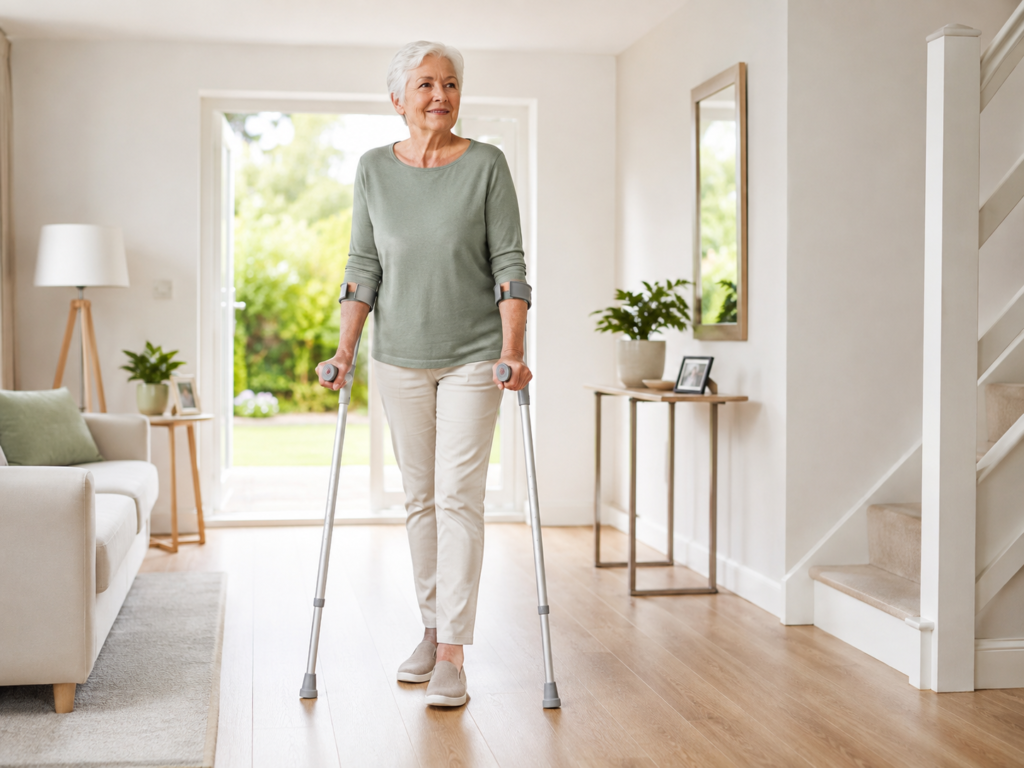
Walking with Crutches: Gait Patterns
A step-to gait is often used when you need more support or need to limit the amount of weight placed through one leg.
To use a step-to gait:
- Move both crutches forward a short distance.
- Step forward with your affected or weaker leg, placing it between or just behind the crutches.
- Push down through the crutch handles for support.
- Bring your unaffected or stronger leg forward to meet the affected leg.
- Once you are stable, move the crutches forward again and repeat.
Keep your steps short and controlled. Avoid placing the crutches too far ahead of you, as this can make you less stable.
As your strength, confidence and ability to take weight through the affected leg improve, you may be advised to progress to a step-through gait. This allows a more natural and continuous walking pattern and is often used when you are able to take more weight through the affected leg.
To use a step-through gait:
- Move both crutches forward a comfortable distance.
- Step forward with your affected or weaker leg.
- Push through the crutch handles as much as required.
- Step forward with your unaffected or stronger leg, allowing it to pass the affected leg.
- Move the crutches forward and repeat.
Try to gradually develop an even, controlled walking pattern rather than rushing. Keep your body upright and look ahead rather than continuously looking down at your feet.
Crutches on the Stairs
You should only use crutches on stairs if you have been shown how to do so and have been advised that it is safe for you.
When first practising stairs, supervision from a physiotherapist, healthcare professional or another appropriate person is recommended.
A useful way to remember the sequence is:
Going up: Good → Bad → Crutch
Going down: Crutch → Bad → Good
Here, “good” refers to your stronger or unaffected leg and “bad” refers to your weaker or affected leg.
Going Up Stairs
- Step up with your unaffected (“good”) leg.
- Bring your affected (“bad”) leg onto the same step.
- Bring your crutch or crutches onto the same step.
- Make sure you are balanced before continuing.
Think: Good → Bad → Crutch.
Going Down Stairs
- Place your crutch or crutches onto the step below.
- Step down with your affected (“bad”) leg.
- Bring your unaffected (“good”) leg down onto the same step.
- Make sure you are stable before continuing.
Think: Crutch → Bad → Good.
Using a Handrail
Where possible, use a secure handrail for additional support.
If there is one handrail:
- Hold the handrail with one hand.
- Hold the crutch in your opposite hand.
- If you normally use two crutches, the second crutch can usually be held alongside the first in the same hand, but only if you have been shown how to do this safely.
- Continue to use the same sequence: Good → Bad → Crutch when going up and Crutch → Bad → Good when going down.
Do not use an unstable banister, furniture or another unsuitable object in place of a secure handrail.
Crutch Safety Advice
Correct technique is particularly important after an operation or injury. Always follow the weight-bearing instructions given by your surgeon, physiotherapist or healthcare team, even if your leg feels capable of taking more weight.
- Make sure your crutches have been correctly adjusted for your height and that the handles, cuffs and rubber ferrules are secure.
- Wear supportive, well-fitting footwear and avoid walking in loose slippers or socks.
- Take particular care on wet, uneven or slippery surfaces, rugs, thresholds and around clutter.
- Keep the crutches reasonably close to your body and avoid reaching them too far ahead or out to the side.
- Do not rush, particularly when turning, standing up or approaching stairs.
- Never hop up or down stairs unless you have specifically been taught to do so.
- When first using stairs, have appropriate supervision or assistance available.
- Only progress your walking pattern, reduce the number of crutches or stop using them when it is appropriate for your recovery.
- If you have been given specific precautions or weight-bearing restrictions following surgery, these take priority over general guidance.
If you feel unsafe, unusually weak or dizzy, or your pain significantly affects your ability to use your crutches, stop and seek advice from your physiotherapist or healthcare team.
This information provides general guidance and does not replace individual assessment or instructions from your surgeon, physiotherapist or healthcare professional.
If you or a relative is preparing to leave hospital – or has recently returned home to Worcester Park, Epsom & Ewell, Stoneleigh or Cheam after a surgery – contact Bee Mobile Physiotherapy to discuss how home-based rehabilitation could support the recovery.
Please include the expected or actual discharge date, the operation details and the person’s current mobility when making an enquiry.
F.A.Q.
Frequently Asked Questions
When standing upright with your arms relaxed, the crutch handles should usually sit around the level of your wrist crease. This should allow a slight bend in your elbows when holding the handles. The cuff should sit comfortably around your forearm without restricting movement.
There is no fixed date. You will usually progress from two walking aids to one as your strength and walking improve, before eventually walking unaided. NHS guidance suggests some people may try walking without an aid from around six weeks if they feel ready.
A common way to remember the sequence is “good leg up, bad leg down.” Going up: stronger leg first, followed by the affected leg and crutch. Going down: crutch first, followed by the affected leg and then the stronger leg. Use a handrail where appropriate and only attempt stairs using the technique you have been taught.
You may be ready to progress when you can walk safely without significant pain, limping or loss of balance and your healthcare professional is happy for you to reduce your support. When using one crutch, it is usually held in the hand opposite the affected leg.
This depends on the walking pattern you have been taught. With a typical step-to or step-through pattern, the crutches move forward first, followed by the affected or weaker leg, then the stronger leg. Always follow any specific weight-bearing instructions provided by your physiotherapist or surgical team.